BMW 328 History
From a brochure shown to a few insiders in 1935 to the Mille Miglia of 1940: how BMW designed the 328, raced it before it sold it, built it at Eisenach until the war, and saw its engine carried off to Britain.
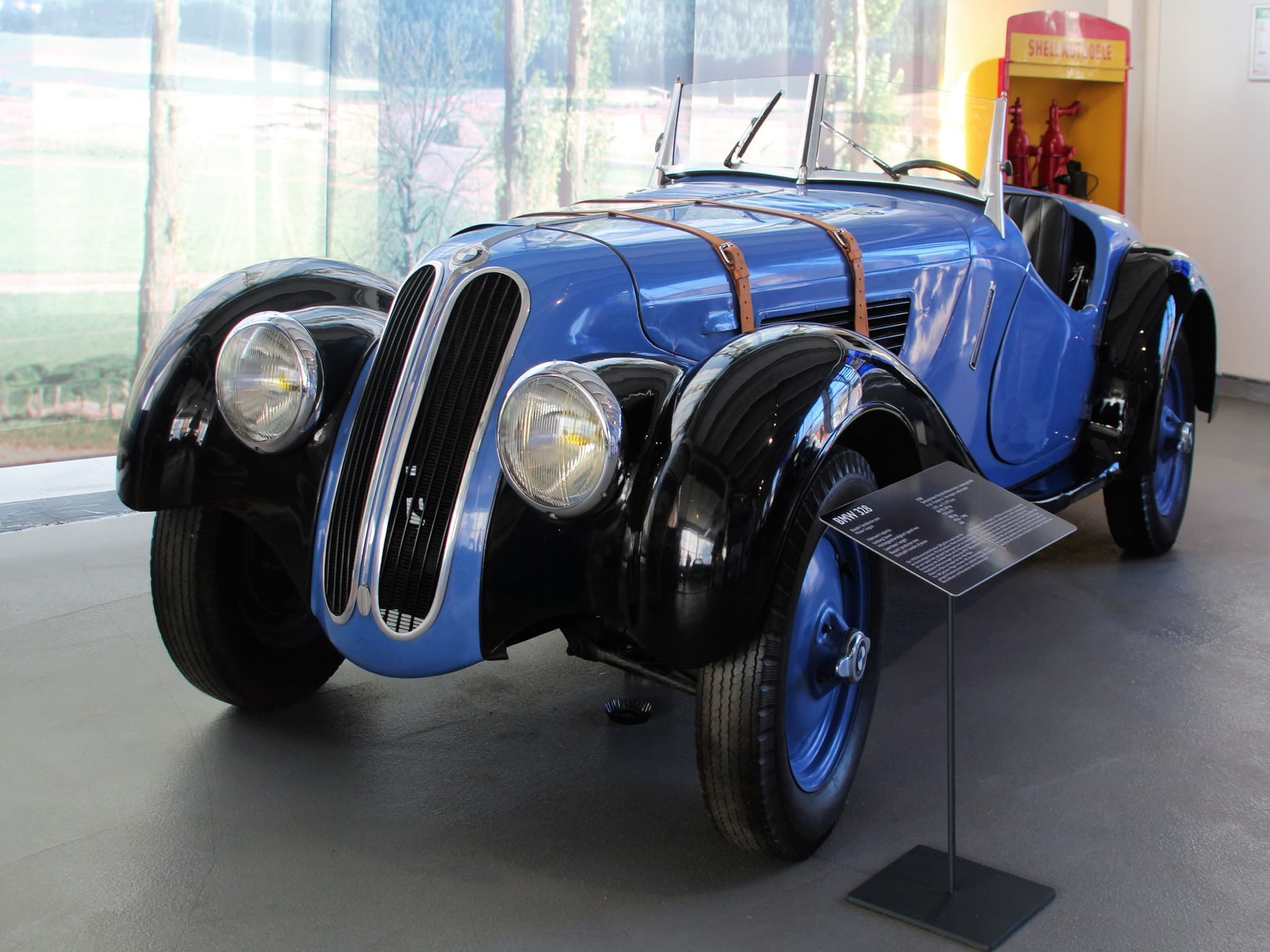
The BMW 328 was announced almost in a whisper.
Only a handful of insiders were let in on the secret, a modest brochure released to this select inner circle in late 1935 revealing the existence of a new 2-litre sports car to be known henceforth under the designation 'Typ 328'.
The brochure gave neither the car's power nor its speed, BMW adds, and when the 328 first raced, at the Nürburgring in June 1936, the press had not been told it was coming. Four years later BMW's Touring coupé won the Mille Miglia outright, and in 1945 the engine was carried off to Britain to begin a second life.source 1source 2source 3source 4
BMW at Eisenach and Munich
BMW was a Munich company with a factory in Thuringia. Its head office and aero-engine works were in Munich; its cars came from Eisenach, where BMW had bought a vehicle works in 1928 under Franz Josef Popp, the chairman of its board from 1922 to 1942.
The BMW firm, with its research and development and racing department in Munich, within the aircraft engine complex, and its automobile manufacturing facility in Eisenach some 200 miles north, was pursuing a very active competition programme
BMW's own account places the car's early development elsewhere. In 1934, it says, it "gathered together its vehicle development activities under the watchful eye of Fritz Fiedler in Eisenach", a team only 20 strong at first, and moved the car development department to Munich in 1937. By BMW's account, then, the 328 was conceived at Eisenach; by Jenkinson's, in Munich.source 5source 6source 1
Forerunners: the 315/1 and 319/1
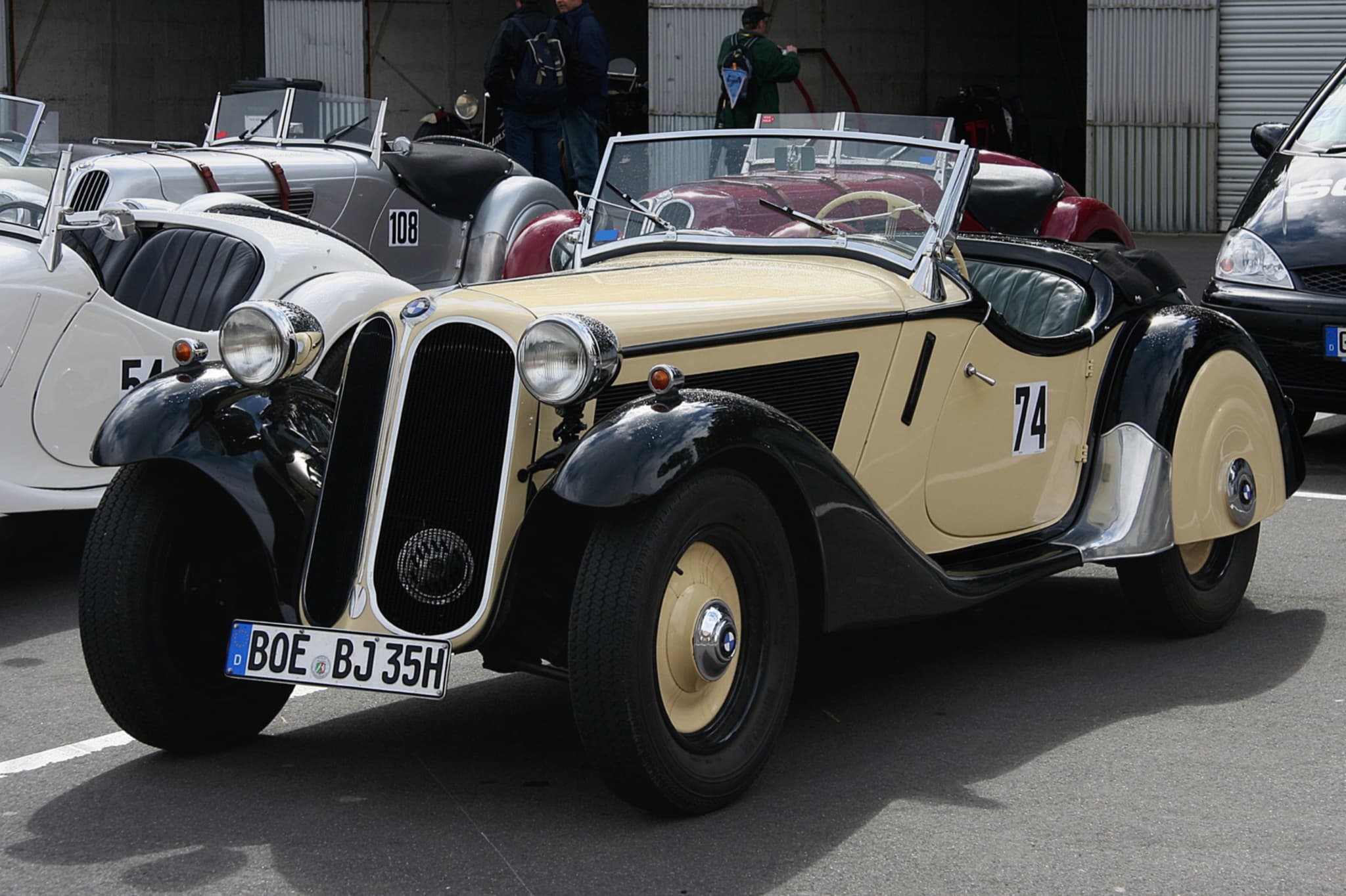
BMW traces the line back to the 303 of 1933, the car that, it says, introduced its principle of lightweight construction, and Jenkinson to "the design concepts laid down in 1932 by Fritz Fiedler and Rudolf Schleicher". The sports cars came in 1934. BMW showed a prototype sports roadster beside its 315 saloon (sedan) at the Berlin Motor Show, in May 1934 by BMW's date, and sold the 315/1 from that summer: a small six in a two-seater with flared wings (fenders) and covered rear wheels, on a welded frame of steel tubes, with a transverse leaf spring and wishbones at the front and a live axle at the back.
Many German motorists see motoring not just as a comfortable and fast means of transport, but also as a sporting activity.
A team of 315/1s won its class in the International Alpine Trial that year, BMW says; Jenkinson first gave that success to the 319, then printed his readers' correction. Late in 1934 came the 319/1, the same car outwardly but for a vent in the bonnet (hood), with a larger six and three bigger downdraught carburettors. Neither sold widely: BMW says 230 315/1s were completed by mid-1935, and 178 319/1s in 1934–36.
The 328 was developed from the 319/1. Jenkinson described the chassis engineers "honing the basic 319 car, improving the brakes, the shock-absorbing, the gearbox and the rear axle", and BMW says the new car "differed significantly in both its exterior appearance and under the skin". The layout stayed; the brakes became hydraulic, the engine took a new head and the body was new.source 1source 7source 6source 8
Who designed it
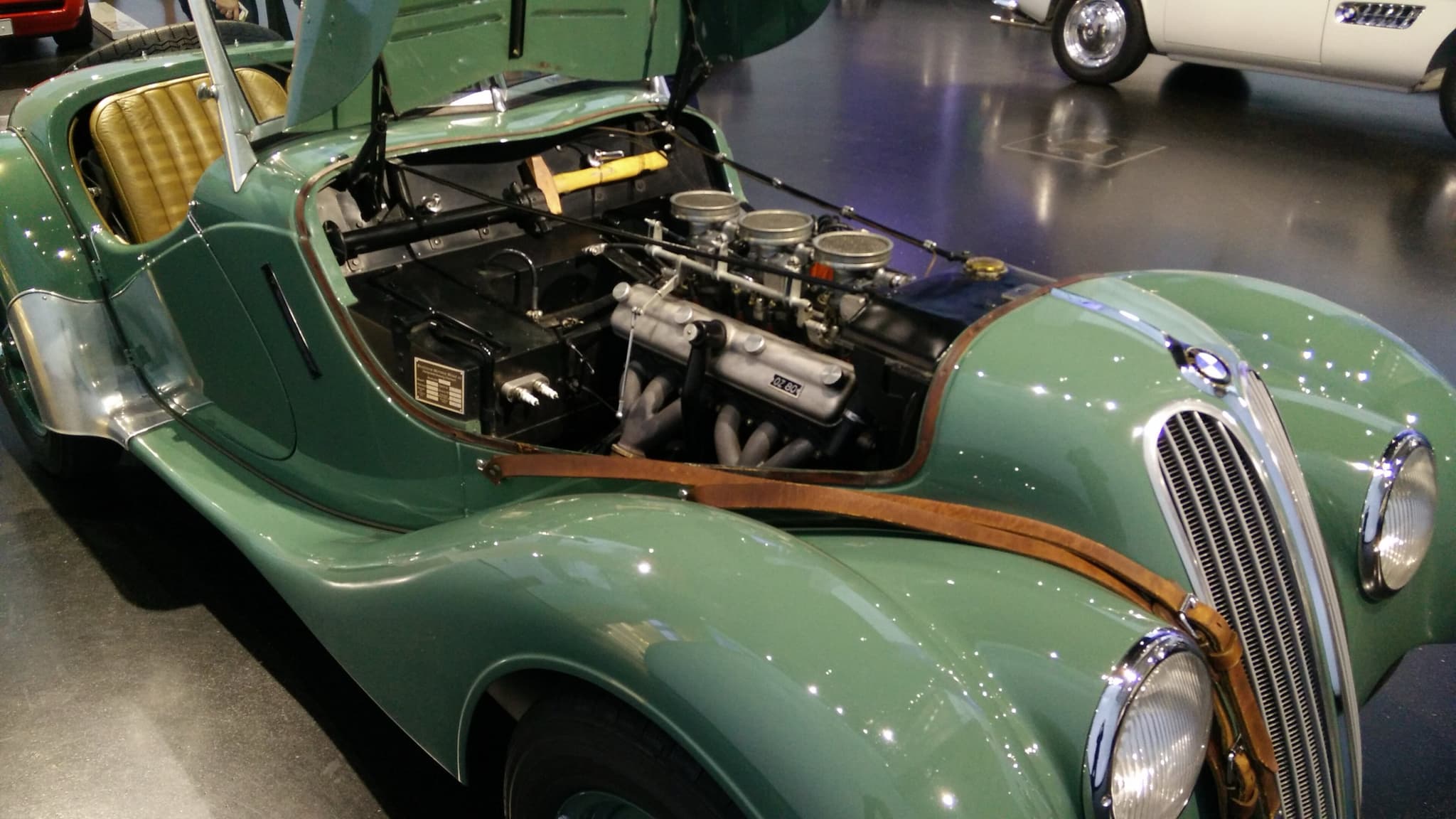
Every reliable source read names two men: Fritz Fiedler for the chassis and Rudolf Schleicher for the engine. Fiedler's frame, which BMW says it patented, had two round tubes converging like an A from the rear wheels to the front, joined by rectangular cross-members. Schleicher's task was the engine's breathing, which Jenkinson says limited its power. His answer was a new aluminium-alloy head on the 326's cast-iron block: valves inclined in a vee over hemispherical chambers, upright inlet ports for three downdraught carburettors, and a single camshaft in the block that reached the far row of valves through short pushrods across the head.
BMW adds a third name. Wilhelm Kaiser, a body engineer who arrived at Eisenach on 1 October 1936, drew the production body, working from the prototypes, in a form that BMW says could be built without elaborate tooling.
BMW is modest about its own car: put together "in double-quick time with minimal use of materials and manpower", "neither overly innovative for its time nor particularly powerful", its strength "the coherence of the overall concept". After the first races, it says, Fiedler and Schleicher set up a racing department so that what the cars learned would reach the production car. On 1 September 1938 BMW founded a design department, "Künstlerische Gestaltung" (artistic design), under Fiedler; there, by BMW's account, the Kamm coupé's body was made under Wilhelm Meyerhuber's stewardship, and he carried its streamlined shape over to the Mille Miglia roadsters of 1940.source 6source 1
The debut, 14 June 1936
The car Ernst Henne drove at the Eifelrennen was a prototype: chassis 85001, painted white, with no doors, a low windscreen (windshield) and, BMW says, a pair of slim kidney-shaped intakes like those of the 326 shown at Berlin that spring. He won the unsupercharged two-litre sports-car race over five laps of the Nürburgring by about three minutes, at an average of 101.6 km/h (63.1 mph), from what BMW says were four 319/1s and the rest of a class it puts at seven cars. BMW adds 250,000 spectators and a lap record for sports cars; the name "Baumuster 328", it says, appeared in none of the race reports.
Three prototypes ran that summer: 85001, 85002 and 85003, the last with right-hand drive. At the sports-car Grand Prix at Montlhéry on 28 June all three retired, two with engine-mounting trouble and one with a broken oil pipe. At the Tourist Trophy at Ards on 5 September, run as the Frazer Nash-BMW team, they finished 3rd, 7th and 9th overall and filled the first three places in the two-litre class. BMW 328 Racing History tells those races.source 2source 9source 10source 1source 6
On sale: London 1936, Berlin 1937
The 328 was offered for sale in Britain before Germany. At the London Motor Show at Earls Court in October 1936 AFN Ltd showed the prototype 85003, now painted white, with delivery promised early in 1937; Motor Sport thought it "probably the most strikingly displayed" sports car of the show. German buyers first saw the production car at the Berlin Motor Show in February 1937. Jenkinson had dated that show to the autumn of 1936, and a month later printed the correction, on Anthony Blight's evidence.
The Berlin car, chassis 85004, was built to the production specification of the roadster, with doors, a folding screen and the spare wheel in its tail. BMW advertised it as a "powerful everyday car for travel and sport".
Customers waited. BMW says the first cars were not delivered until late April 1937, that the three prototypes went on taking turns to win races in the meantime, and that the 200th car reached its owner in the spring of 1938. The price new in Germany and in Britain is in the specifications; the British price was, Jenkinson wrote of 1938, "slightly more than the price of an average London semidetached house!"source 6source 8source 11source 1source 12
Production, 1936–40
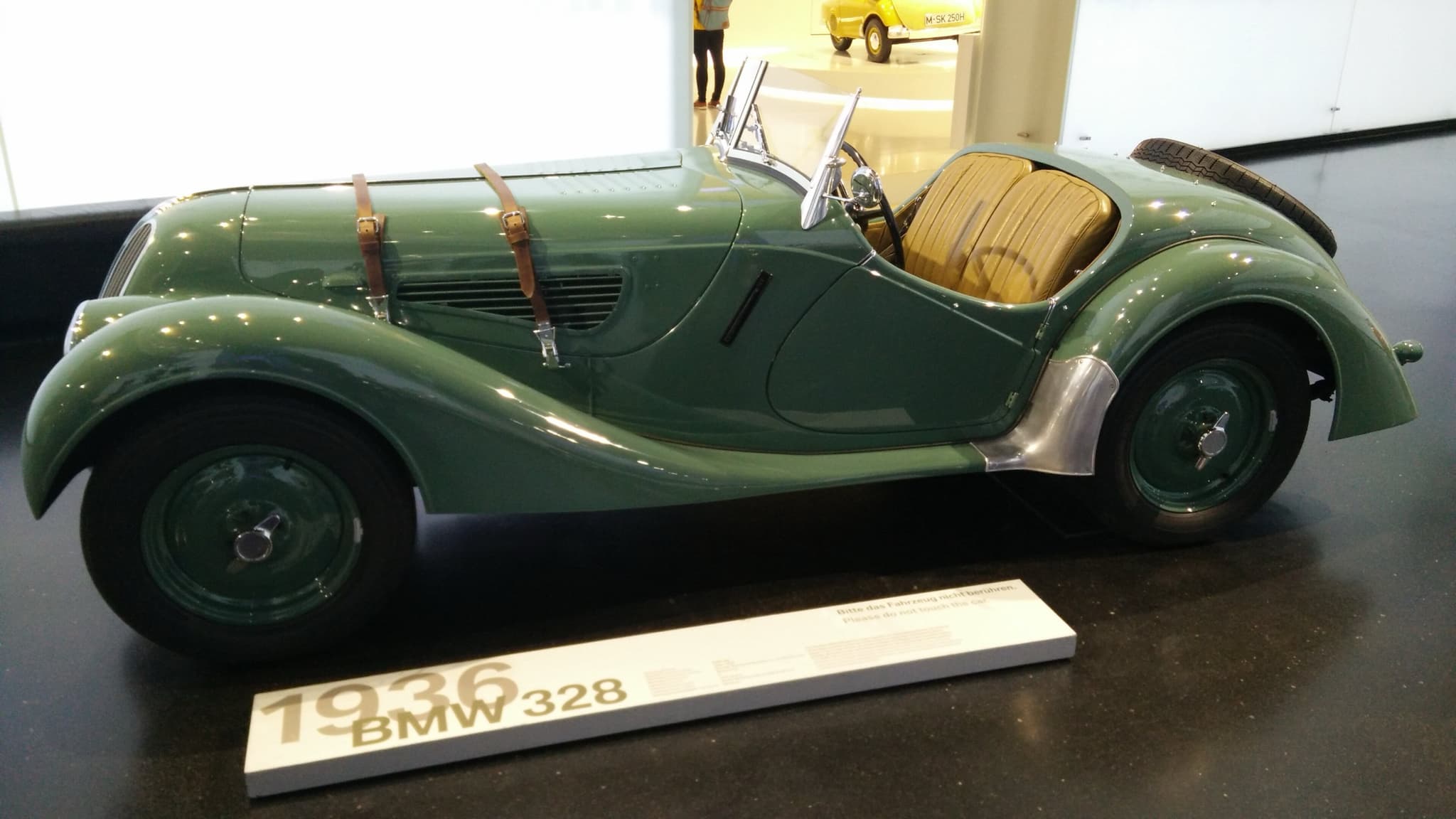
Every 328 was built at Eisenach. How many were built the sources do not agree, and none says what its total counts: chassis numbers issued, cars completed or cars delivered, or whether the racing cars of 1940 are among them. The specifications lead with BMW's figure, from its archive record, and give the others beside it. Jenkinson gave a reason for caution: the chassis numbers ran to 85464, with some numbers skipped and others used twice.
BMW's 2011 data sheet says most of the cars had the standard roadster body, and that the rest were given racing bodies or bodies built to customers' orders. Production ended with the war. Jenkinson wrote that the car was built at Eisenach "during 1937, 1938 and up to August 1939, when war caused BMW to make other things"; BMW's archive record dates the model 1936 to 1940, and BMW writes that its cars were produced "up to 1940".source 6source 13source 1source 14
Other markets
Britain is the market abroad that the record covers best. H. J. Aldington's AFN Ltd agreed with BMW at the end of 1934 to sell its cars in Britain, and fitted them with Frazer Nash-BMW badges; Bill Boddy wrote in Aldington's obituary that the BMW reached Isleworth in 1935 under that name. The 328 followed from 1937, with right-hand drive. The Frazer Nash-BMW 328 page tells the British cars' story: how many came, how they differed and what the British press made of them.
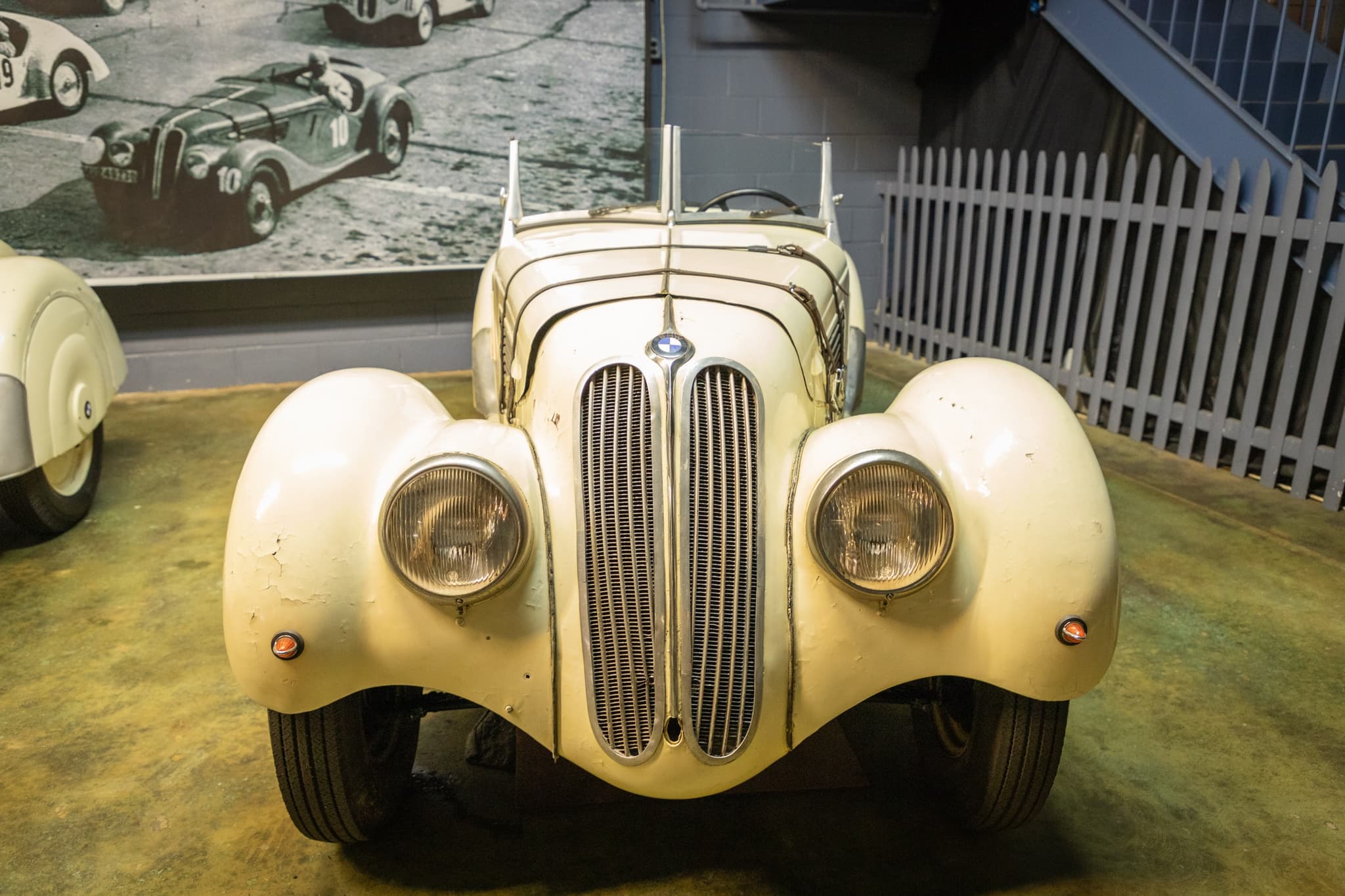
Elsewhere the evidence comes car by car. The Simeone Foundation's 1937 roadster, by BMW's factory archives as the museum cites them, was delivered to the Dutch BMW importer in Rotterdam on 13 February 1938, in the ivory white it still wears. And private owners raced 328s across Europe before the war: at Zandvoort in June 1939 three Dutch drivers took the first three places in the two-litre class, and privately run 328s raced in Belgium, Switzerland, Romania and Finland.source 15source 16source 17source 18source 19source 9
Contemporary rivals
In Britain the 328's rivals can be priced. Motor Sport printed a buyers' list each October, and in the lists of 1937 and 1938 the Frazer Nash-BMW 328 cost more than the SS 100, the HRG and the Triumph Dolomite, and less than the Aston Martin Speed Model and the Alfa Romeo 6C 2300 B. Its own price is in the specifications.
| Car | British list price | Motor Sport's list |
|---|---|---|
| Triumph Dolomite six | £388 | October 1937 |
| SS 100 2½-litre | £395 | October 1937 |
| HRG 1½-litre | £395 | October 1937 |
| SS 100 3½-litre | £445 | October 1937 |
| Aston Martin Speed Model, streamlined body | £775 | October 1938 |
| Alfa Romeo 6C 2300 B, short saloon | £1,070 | October 1937 |
The SS 100 was the cheap way to the same speed: in August 1939 Motor Sport called the 3½-litre the cheapest car of its pace ever sold off a production line, and turned straight to the BMW.
So far as Continentals are concerned, the ever-amazing 2-litre Type 328 Frazer-Nash-B.M.W. stands right out with a maximum of over 100 m.p.h. and stamina, control and getaway which win for it race after race, rally upon rally.
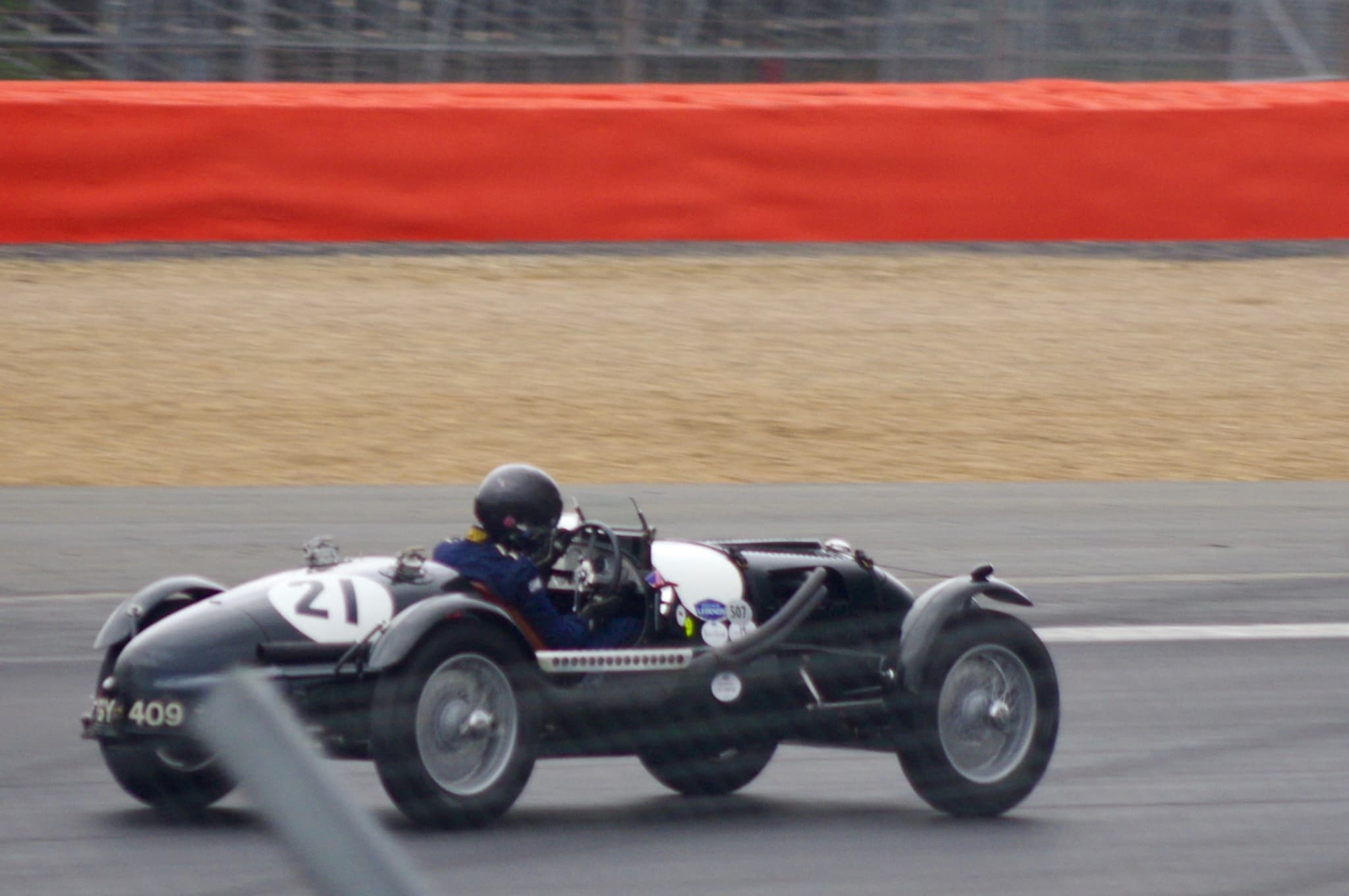
On the track its class rivals were the Aston Martin Speed Model, Adler's streamlined saloons and, in Italy, the Alfa Romeos, and BMW 328 Racing History sets the results side by side.source 20source 21source 22source 2source 23
The first reviews
The German press, BMW says, was not told the car was coming, and the race reports of June 1936 praised Henne's drive without naming the car. BMW quotes one of them in translation.
Henne squeezed incredible performance out of his new 2-litre car … What magnificent acceleration! (...) this sports car is quicker than all its supercharged rivals! Henne takes the victory by a clear margin.
In Britain the early verdicts are Motor Sport's. On AFN's stand at Earls Court in 1936 the car "presents food for thought", because a push-rod engine "developing not excessive power" gave it its speed: "Good output low down and thus an ability to pull a high top-gear ratio is the clue." In October 1937 the magazine judged the Frazer Nash-BMW more a fast touring car than a sports car, and reliable for it; in February 1938 it wrote of "The wonderful Type 328 Frazer-Nash-B.M.W,, possessed of perhaps the highest allround performance in relation to engine capacity of any push-rod production sports-car". In August 1940, in wartime, Cecil Clutton went further: "To Germany it has fallen to build the most advanced of all sports-cars, the B.M.W." The British road tests are on the Frazer Nash-BMW 328 page.source 1source 11source 20source 24source 25
The war
War ended the works team as well as the car. In German races of 1938 and 1939 several works cars were entered in the name of the NSKK, and BMW itself describes Prince Max zu Schaumburg-Lippe, who drove the coupé at Le Mans in 1939, as "the NSKK (National Socialist Motoring Corps) team's leading driver". "The political situation meant that only a handful of races took place in 1939 and 1940," BMW writes. The last of them for the works cars was the Mille Miglia of 28 April 1940, run on a closed circuit from Brescia; Motor Sport's report that June noted that a German car had won it while Germany was fighting a major war. Early in 1941, BMW says, its racing division was disbanded, and its director, Ernst Loof, and most of his staff were sent by the Luftwaffe to an aero-engine repair shop in Paris.
In Britain AFN lost its supplier. "That the source of supply of this wonderful car is the country with which we are at war is very bad luck on the Aldingtons' part," Motor Sport wrote in November 1940. The works team's last seasons are on BMW 328 Racing History.source 9source 1source 3source 26source 27source 28
After 1945
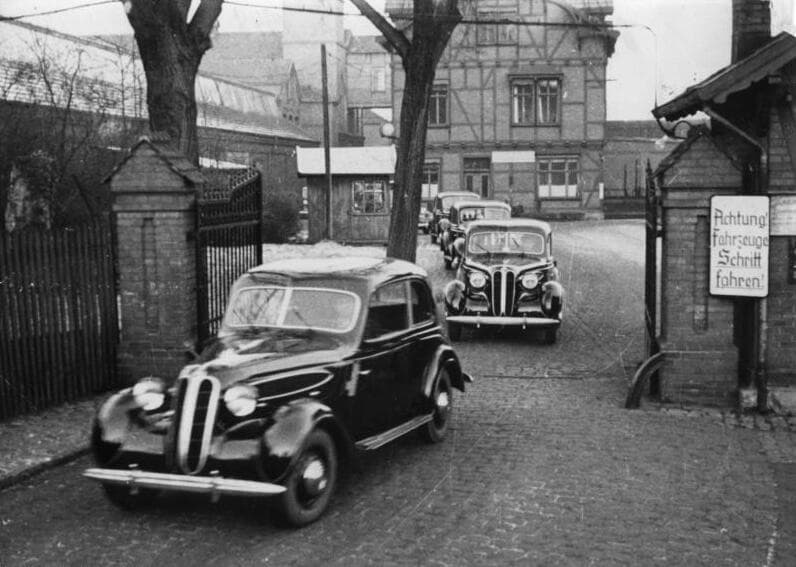
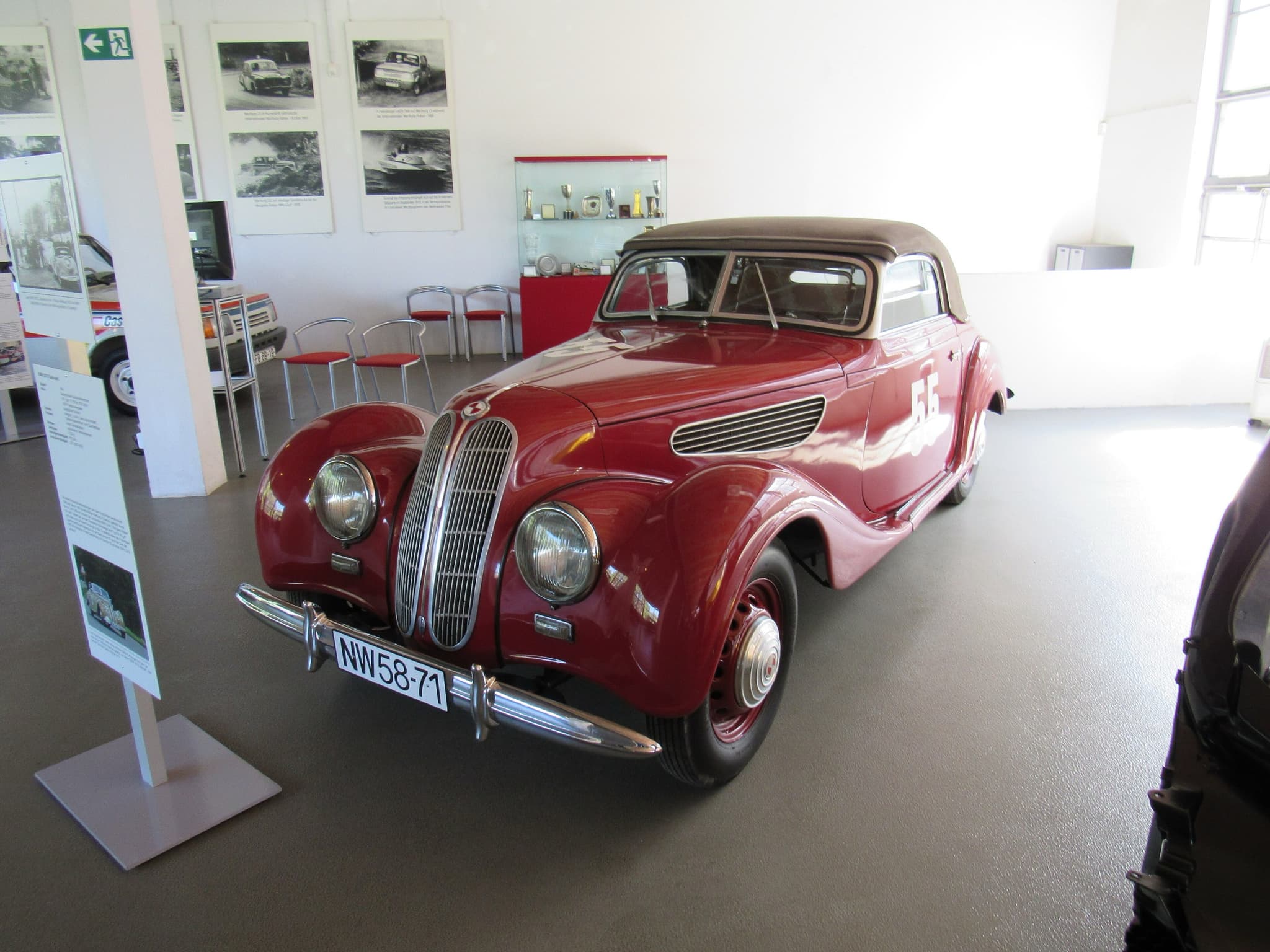
Eisenach built cars again after the war, saloons like those in the gate photograph above and later EMWs, but no source read records a 328 built there after 1945. The racing cars scattered. In 1945 Aldington brought one of the 1940 Mille Miglia roadsters to England, and BMW's own account has the three roadsters turning up after the war in Russia, England and America. The Touring coupé, BMW says, went to Canada at the end of 1947, and it raced in American events from 1949 to 1952 before BMW acquired it in 2002. The Kamm coupé won once more: Karl Kling drove it to victory at Hockenheim on 11 May 1947, entered by Loof, and it was scrapped after an accident in the early 1950s.
Fritz Fiedler ended the war in Munich, in the American zone, by the Frazer Nash Archives' account, and in 1947 joined AFN, which lent him to Bristol as a consultant on its Type 400. By then Aldington, working with the Bristol Aeroplane Company, had brought BMW's drawings and engines from Munich, and Bristol's first engine on the 328's pattern had run, by its own historians' account, in May 1946. BMW 328 Engine follows it from there.source 17source 29source 27source 9source 30source 15source 4
Successors and heirs
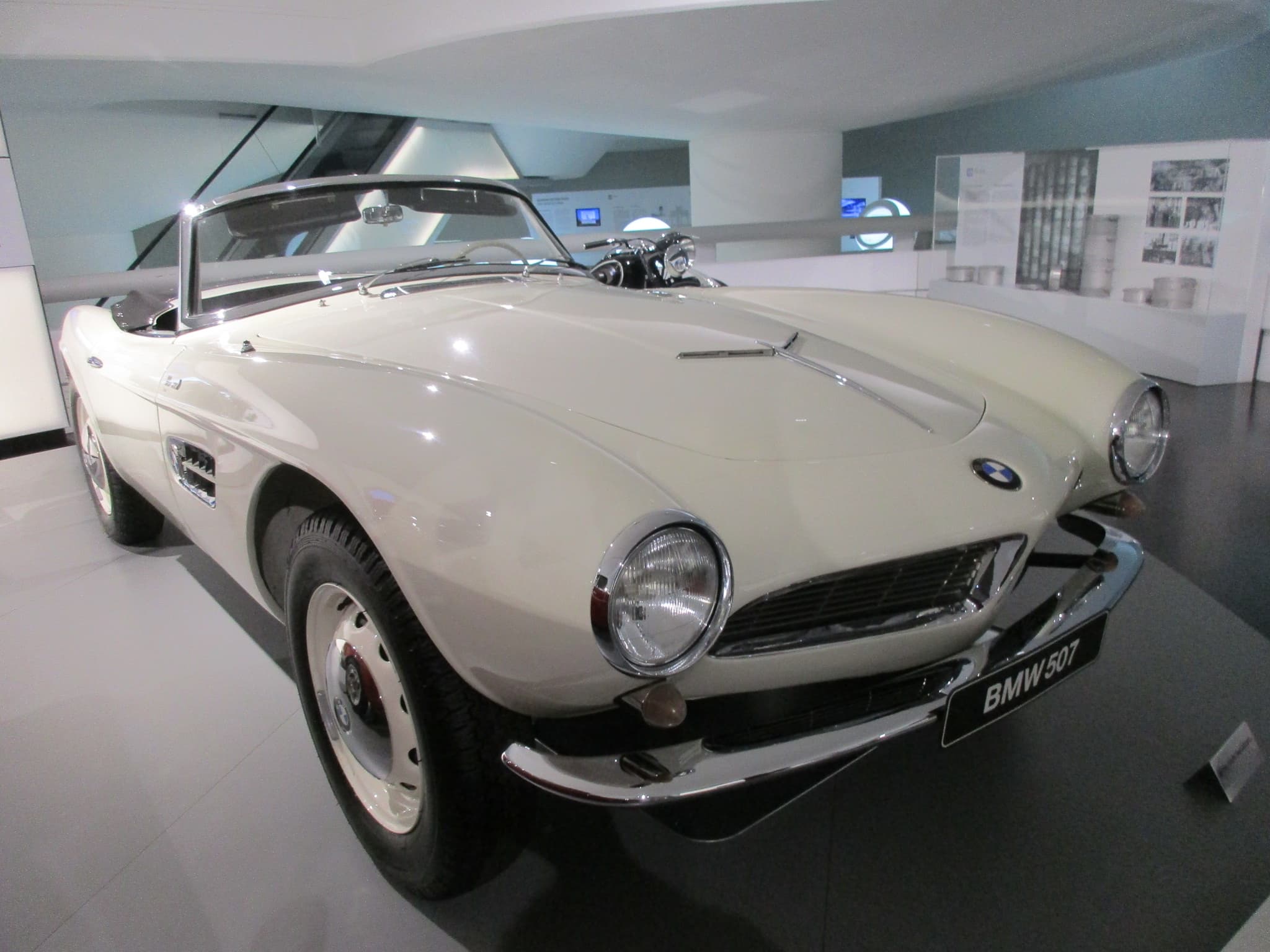
The 328 had no direct successor. Production stopped with the war, and BMW built its next sports two-seater only in the 1950s.
While the 328 paved the way for BMW's sporting activities, the Company's next two-seater sports car set new standards in design and elegance as of the mid-50s: the BMW 507.
BMW names one inheritance of its own: the nine-counterweight crankshafts of the 1940 race engines, whose experience, it says, went into the engine of the post-war 501. In Britain the line ran through the engine. The Bristol 400, which began leaving the factory in 1947, used Bristol's development of the 328's six, and Bristol supplied the same engine to the post-war Frazer Nashes, for which, the Frazer Nash Archives say, the 1940 roadster Aldington had brought back was the inspiration. "The post-war Frazer Nash appeared, clearly developed from the 328 model, with engine by Bristol from the original 328 BMW design," Jenkinson wrote. In Germany, as he put it, "many 328 BMWs had been given a new lease of competition life by small tuning establishments, such as AFM and Veritas".source 7source 1source 4source 17source 12
Reputation and anniversaries
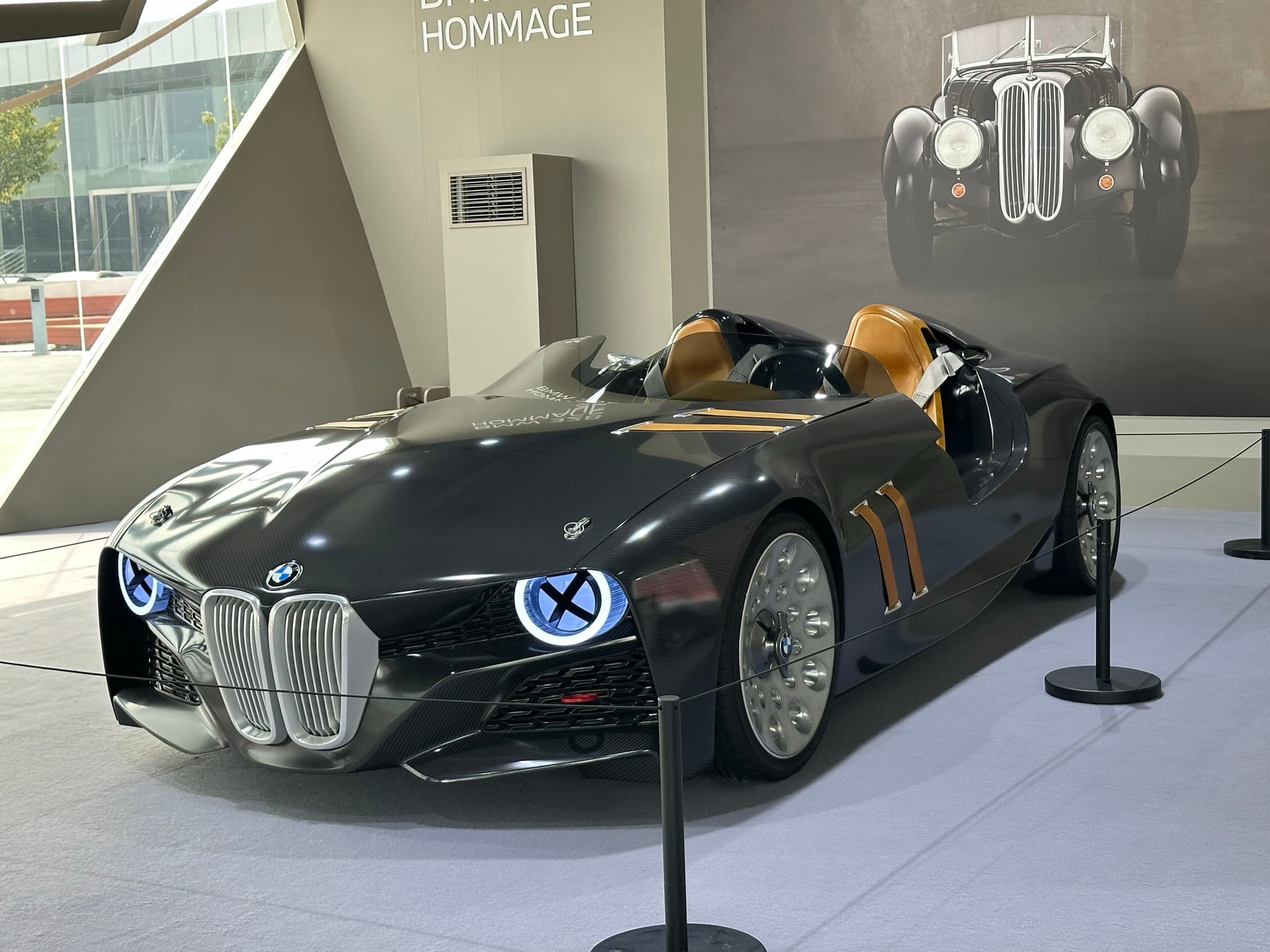
BMW calls the 328 "the most successful sports car of the 1930s on the racing scene". Its birthdays have been kept since at least 1986, when Jenkinson reported "numerous gatherings" in Germany for its fiftieth. For the 75th, in May 2011, BMW published a long account of the car and unveiled the BMW 328 Hommage at the Concorso d'Eleganza Villa d'Este.
It set a standard in modern sports cars that was not surpassed until the 1950s and not outmoded until 10 years later.
At the same Concorso in May 2026 the Best of Show went to the "Bügelfalte": chassis 85032, rebodied in Munich in the autumn of 1939 and 6th in the Mille Miglia of 1940, honoured almost 90 years after Henne's first win.source 1source 6source 31source 3source 32
Sources
Every source the site cites is on the sources page.
- Primarymade at the time, by the maker or by people who were there
- Referenceserious later work: clubs, specialists, magazines, books
- Databaseresults and listings, entry by entry
- BMW AG (BMW Group PressClub Global), "The BMW 328 turns 75" (press kit), 11 May 2011, "The premiere of the BMW 328": the brochure of late 1935; "The 'Künstlerische Gestaltung' department": development at Eisenach from 1934, moved to Munich in 1937; the 303 and lightweight construction; developed on the basis of the 319/1; the creators; the frame; Wilhelm Kaiser and the body; the racing department; "Künstlerische Gestaltung" and Wilhelm Meyerhuber; "An impressive debut": the field, the spectators, the lap record, the grille; "Series production begins": the equipment, the slogan, the first deliveries and the 200th car; "up to 1940"; the debut unannounced; "Baumuster 328" in no report; Die Motorwelt, in BMW's translation; Schaumburg-Lippe and the NSKK at Le Mans, 1939; "The political situation"; the race crankshafts and the 501; "the most successful sports car of the 1930s on the racing scene"; the anniversary account; the Bügelfalte body of autumn 1939. press.bmwgroup.com/global/article/detail/T0107839EN Primary
- racingsportscars.com, Race results pages with BMW 328 entries, 1936–48 (group), Eifelrennen, 14 June 1936; Eifelrennen, 14 June 1936; GP de l'ACF, Montlhéry, 28 June 1936; Tourist Trophy, Ards, 5 September 1936; Le Mans 1937 (Adler); Tourist Trophy, Donington, 3 September 1938 (Aston Martin). racingsportscars.com Database
- racingsportscars.com, Mille Miglia 1940, results, the 1940 result; 28 April 1940; No. 71, 85032, 6th. racingsportscars.com/results/Mille_Miglia-1940-04-28.html Database
- Jonathan Wood, "Bristol 400", Bristol Owners Heritage Trust, 10 Jun 2020, the engine to Britain, 1945; Aldington in Munich, 1945; the first Bristol engine, May 1946; the Bristol 400; engines for the post-war Frazer Nashes. bristolownersht.com/2020/06/10/bristol-400-by-jonathan-wood Reference
- Patrick Oelze, "Popp, Franz Josef", Neue Deutsche Biographie, vol. 20 (2001), pp. 623–624, chairman of the board, 1922–42; the Eisenach works bought in 1928. deutsche-biographie.de/sfz96825.html Reference
- Denis Jenkinson ("D.S.J."), "BMW type 328: fifty years ago", Motor Sport, Jun 1986, p. 40, p. 40, Munich and Eisenach; the quotation; p. 40, the design concepts of 1932; the 319 honed into the 328; p. 40, Fiedler and Schleicher; the head and its valve gear; p. 40, the three prototypes; Montlhéry; the Tourist Trophy; p. 40, 85003 at Earls Court; 85004 to production specification; p. 40, built at Eisenach to August 1939; the last chassis number; p. 40, the gatherings of 1986; the closing verdict. motorsportmagazine.com/archive/article/june-1986/40/bmw-type-328-fifty-years-ago Reference
- BMW AG (BMW Group PressClub Global), "75 years of the BMW Roadster. The BMW 315/1 and its Successors" (press release), 28 May 2009, the 315/1 and 319/1: the Berlin show, the car, the 1934 Alpine Trial, the numbers built; BMW's 1934 announcement; the 507 as "the Company's next two-seater sports car". press.bmwgroup.com/global/article/detail/T0022475EN Primary
- Denis Jenkinson ("D.S.J."), "328 BMW Addendum", Motor Sport, Jul 1986, p. 50, p. 50, the 1934 Alpine success the 315's, not the 319's; p. 50, Berlin in February 1937; London the first sale. motorsportmagazine.com/archive/article/july-1986/50/328-bmw-addendum Reference
- racingsportscars.com, "BMW 328 – All Results", chassis column, 1936: 85001, 85002, 85003; private entrants abroad: Zandvoort, 3 June 1939; Chimay, Bucharest and Helsinki, 1937–39; the entrant column, German races of 1938–39: "NSKK"; 85368 in American races, 1949–52. racingsportscars.com/type/results/BMW/328.html Database
- Motor Sport, "The Eifel Races", Jul 1936, p. 6, the unsupercharged 2-litre sports-car race. motorsportmagazine.com/archive/article/july-1936/6/the-eifel-races Primary
- Motor Sport, "On the Earl's Court Show", Nov 1936, p. 23, p. 23, AFN's stand; p. 23, "food for thought". motorsportmagazine.com/archive/article/november-1936/23/on-the-earls-court-show-2 Primary
- Denis Jenkinson ("D.S.J."), "Frazer Nash-BMW type 328" ("In resurgam"), Motor Sport, Feb 1988, p. 40, p. 40, the price in 1938 against a London house; p. 40, the post-war Frazer Nash; AFM and Veritas. motorsportmagazine.com/archive/article/february-1988/40/in-resurgram Reference
- BMW Group Archive (BMW Group Classic), Type record "Baumuster BMW 328" (AD-122-1), "Bauzeit 1936–1940"; the number built. bmw-grouparchiv.de/research/detail/index.xhtml?id=3837210 Primary
- BMW Classic (BMW Group PressClub Global), "BMW 328" (data sheet), 11 May 2011, "History": the standard bodies and the rest. press.bmwgroup.com/global/article/detail/T0107839EN Primary
- The Frazer Nash Archives, "Personalities", H. J. Aldington: the agreement at the end of 1934; the Frazer Nash-BMW badges; Fritz Fiedler: in Munich, in the American zone, at the end of the war; AFN from 1947. frazernasharchives.co.uk/index.php?idPage=12 Reference
- W.B., "Obituary – H. J. Aldington", Motor Sport, May 1976, p. 33, the BMW at Isleworth in 1935. motorsportmagazine.com/archive/article/may-1976/33/obituary-hjaldington Reference
- The Frazer Nash Archives, "Frazer Nash-BMW", the 328 Sports, imported 1937 to 1939; one of the 1940 Mille Miglia cars brought to England in 1945; the 1940 roadster as the post-war Frazer Nash's inspiration. frazernasharchives.co.uk/index.php?idPage=35 Reference
- BMW Historic Motor Club, "Specifications: BMW 328", the right-hand-drive cars. bmwhistoricmotorclub.co.uk/cars/bmw-328 Reference
- Simeone Foundation Automotive Museum, "1937 BMW 328" (collection page), delivered to the Dutch BMW importer in Rotterdam, 13 February 1938, by BMW's factory archives. simeonemuseum.org/collection/1937-bmw-328 Reference
- Motor Sport, "A Guide to 1938 High Performance Cars", Oct 1937, p. 19, p. 19, the Triumph, S.S., H.R.G. and Alfa-Romeo entries; p. 19, the Frazer-Nash-B.M.W. paragraph. motorsportmagazine.com/archive/article/october-1937/19/a-guide-to-1938-high-performance-cars Primary
- Motor Sport, "A Guide to 1939 High Performance Cars", Oct 1938, p. 23, p. 23, the Aston-Martin entry. motorsportmagazine.com/archive/article/october-1938/23/a-guide-to-1939-high-performance-cars-2 Primary
- Motor Sport, "On Performance for Sale", Aug 1939, p. 9, p. 9, the S.S. 100 and the Type 328; the quotation. motorsportmagazine.com/archive/article/august-1939/9/on-performance-for-sale Primary
- racingsportscars.com, Mille Miglia 1938, results, the Alfa Romeo 6C 2300 B MM, 9th. racingsportscars.com/results/Mille_Miglia-1938-04-03.html Database
- Motor Sport, "The Trend of Design", Feb 1938, p. 27, p. 27, "The wonderful Type 328". motorsportmagazine.com/archive/article/february-1938/27/the-trend-of-design-5 Primary
- Cecil Clutton, "The vintage-modern Axis", Motor Sport, Aug 1940, p. 13, p. 13, the BMW paragraph. motorsportmagazine.com/archive/article/august-1940/13/vintage-modern-axis Primary
- Motor Sport, "The Brescia Grand Prix", Jun 1940, p. 18, p. 18, a German win in wartime. motorsportmagazine.com/archive/article/june-1940/18/brescia-grand-prix Primary
- BMW Group (BMW Group PressClub USA), "Return of a Legend: BMW Group Mobile Tradition acquires the BMW 328 Coupé Touring – Winner of the 1940 Mille Miglia" (media information), 22 Oct 2002, the racing division disbanded early in 1941; Loof sent to Paris; the Touring coupé to Canada at the end of 1947; acquired by BMW in 2002. press.bmwgroup.com/usa/article/detail/T0022145EN_US Primary
- Motor Sport, "On selling sports-cars", Nov 1940, p. 12, p. 12, the Aldingtons' supplier. motorsportmagazine.com/archive/article/november-1940/12/selling-sports-cars Primary
- BMW Group (BMW Group PressClub Global), "Back to the future: the BMW 328 Kamm Coupé" (press release), 23 Apr 2010, the 1940 roadsters found again after the war in Russia, England and America; the Kamm coupé scrapped in the early 1950s. press.bmwgroup.com/global/article/detail/T0079675EN Primary
- racingsportscars.com, Hockenheim 1947, results, 11 May 1947: Kling 1st, chassis 85287, entrant Ernst Loof. racingsportscars.com/results/Hockenheim-1947-05-11.html Database
- BMW Group (BMW Corporate Communications, PressClub USA), "BMW 328 Hommage" (press release), 20 May 2011, the Hommage at Villa d'Este, May 2011. press.bmwgroup.com/usa/article/detail/T0110136EN_US/bmw-328-hommage Primary
- BMW Group (BMW Group PressClub Slovenia), "'Best of Show': BMW 328 'Bügelfalte' wins the Trofeo BMW Group" (media information), 17 May 2026, Best of Show, May 2026. press.bmwgroup.com/slovenia/article/detail/T0457929SL Primary