driver
H. J. Aldington
Managing director of AFN Ltd, the Frazer Nash company at Isleworth, which sold BMWs in Britain as Frazer Nash-BMWs, and a driver of the works 328s in 1936–37.
BMW's chairman, the engineers who made the BMW 328 at Eisenach and Munich and the men who drew its bodies; the drivers who raced it for BMW and, in Britain, for AFN; the coachbuilder and the professor behind its coupés; and the engineer who wrote its history.
About the pictureA BMW 328 at the Harewood hill climb in 2010; none of the people on this page is in it
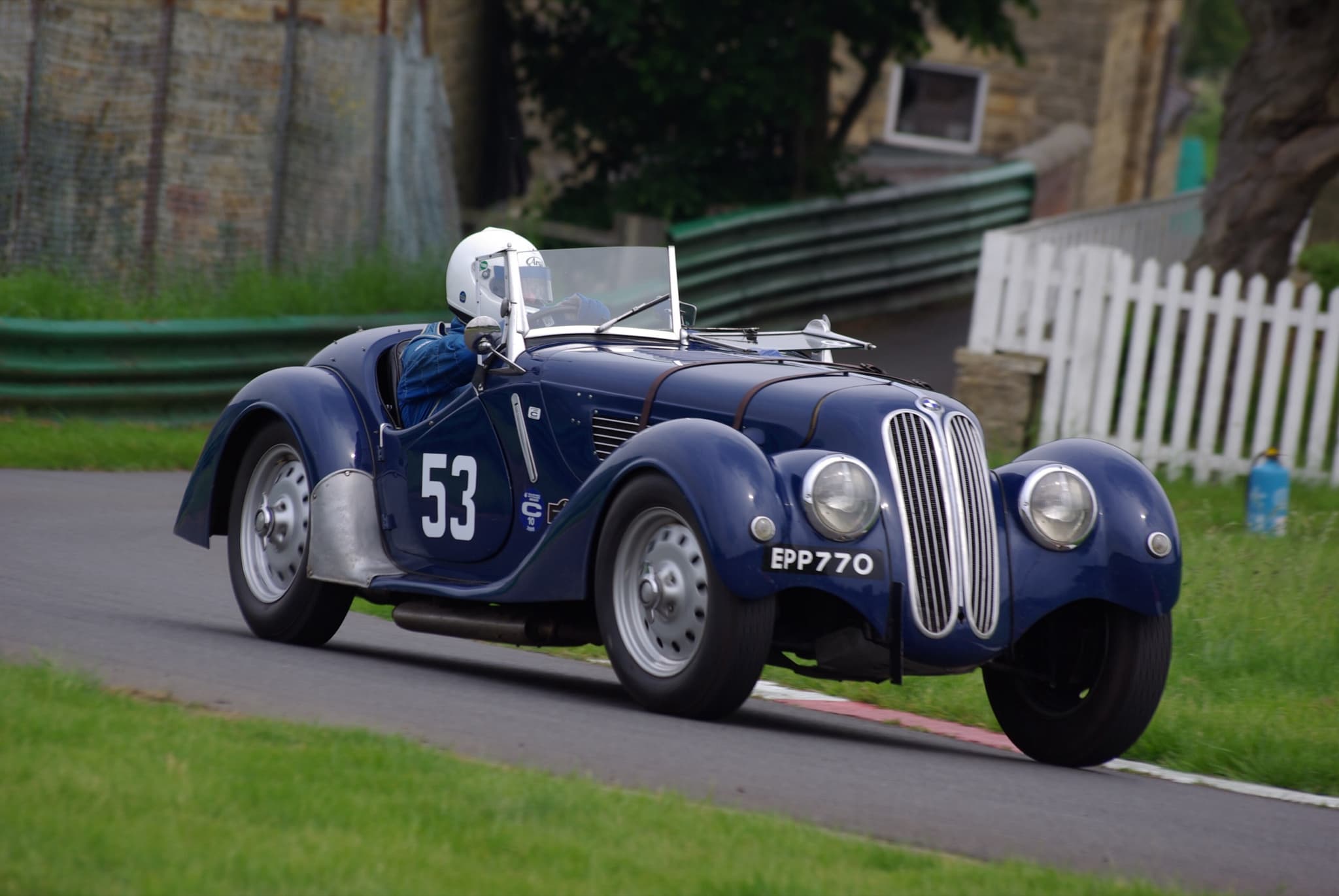
Two of the men behind the BMW 328 were born in Basel: Wunibald Kamm in 1893, the Stuttgart professor whose name the Kamm coupé carries, and Rudolf Schleicher in 1897, who designed the car's engine. Most of the others were BMW's own people, at Eisenach and in Munich, or the drivers who raced the car for BMW and, in Britain, for AFN.source 1source 2source 3
Franz Josef Popp (1886–1954) ran BMW almost from its start. An engineer from Vienna, he came to the Rapp engine works in Munich at the end of 1916 to oversee the licence-building of an aero engine for the Austro-Hungarian navy, stayed when Rapp became BMW in July 1917, and from 1922 chaired its board. In 1928, the Neue Deutsche Biographie (NDB) records, BMW under Popp bought the vehicle works at Eisenach, the Dixi works, and began to make cars. The NDB also records how his years at BMW ended. In 1942 aero engines brought in over 72 per cent of BMW's turnover, and by June about 12,000 of its some 38,000 workers were foreign and forced labourers; that month, after Erhard Milch, the Generalluftzeugmeister, accused him of refusing to deliver and of sabotage, Popp was sent on leave.
Fritz Fiedler (1899–1972), the 328's chassis designer, came to BMW in 1932 from Horch, where, the Frazer Nash Archives say, he had designed eight-cylinder and V12 cars and worked with Schleicher. At Eisenach he had charge of BMW's cars as a whole, the Archives go on, with chassis, suspension and aerodynamics his own speciality, and in the war he worked on military vehicles. The Archives' fullest account is of his years with AFN from 1947, when he led the work on its post-war car at Isleworth. There, they say, he was always called Dr Fiedler, though he held no such title in Germany, and in 1950 he went back to Germany.
Rudolf Schleicher (1897–1989), Rolf in the NDB's entry, came to Munich with his parents in 1900, studied mechanical engineering there from 1919 to 1922 and joined BMW as a designer. In 1924 he drew an overhead-valve sports twin for its motorcycles, under the technical director Max Friz; he tested his engines himself, and in 1926 he won the first German gold medal at the International Six Days Trial in England. From 1927 he ran the testing of Horch's eight-cylinder engines at Zwickau. Back at BMW from 1931, he took over its motorcycle and car department as technical director in 1934, and his team's new motorcycle had a welded tubular frame and a hydraulic telescopic fork, patented in 1937 in the names of Schleicher, A. Böning, Alexander von Falkenhausen and J. Hopf. In August 1945 he started a firm of his own in Munich, making engine parts and camshafts above all, and from 1957 to 1962 he worked with Ludwig Apfelbeck on BMW's small cars.
BMW's own history adds a body man: Wilhelm Kaiser, who drew the production body at Eisenach, moved with car development to Munich in 1937 and took over the body design office at Milbertshofen. Ernst Loof, who ran BMW's racing department, by BMW's account, went on after the war to build racing sports cars from 328s at his own firm, Veritas, as BMW 328 Engine tells.source 4source 5source 6source 2source 3source 7source 8
Ernst Henne's motorcycle record of 1937 was set with the supercharged engine of the racing machine Schleicher's department had built in 1935, by the NDB's account. The Deutsche Biographie's index records his birth at Weiler im Allgäu and his death on Gran Canaria.
Huschke von Hanstein (1911–1996) had driven Adlers at Le Mans in 1937 and at Spa in 1938, where his finished behind the three works 328s, before he won the 1940 Mille Miglia for BMW in the Touring coupé, with Walter Bäumer; BMW 328 Racing History follows his seasons. He drove 328s again in 1949: 3rd at Saarbrücken in September, and at Cologne in October, where he retired. When he died, in March 1996, Dan and Eva Gurney wrote to Motor Sport about the years that came after.
It is in large part due to him that Porsche acquired its very special image and became so well known in its early years when he led a small and enthusiastic racing team to victories all over the world.
Count Giovanni Lurani, born on 19 December 1905, who drove for BMW in both its Mille Miglias, was a doctor of engineering: he had the small Guzzi-engined Nibbio record cars built under his supervision, edited two of Italy's leading motoring magazines and wrote "the first definitive biography" of Tazio Nuvolari, Motor Sport recalled in its obituary of April 1995.
Alex von Falkenhausen (1907–1989), Schleicher's co-patentee on the fork, raced a 328 before and after the war, and the register of notable cars follows the car racingsportscars gives him. After the war, by BMW's account, the cars he raced were his own, built under the AFM name, and in 1948 he was Germany's sports-car champion; he was back at BMW from 1954 as head of its racing, took on its engine development as well in 1957, and retired in 1976.source 2source 9source 8source 10source 11source 12source 13source 14
H. J. Aldington (1902–1976), "Aldy", started as an apprentice at GN in 1920 and sold Frazer Nashes from 1925, the Frazer Nash Archives say; he was managing director of AFN from the end of the 1920s until 1965, when his son took over the running of the firm. He won a Coupe des Glaciers on the Alpine Trial three years running, from 1932 to 1934. With the 328 he raced as well as sold, and BMW credits him with more than his own drives: it was Aldington, BMW wrote in 2011, who "urged the BMW top brass to enter another race outside Germany", and the prototypes went to Ards. His last races came in 1949: the Mille Miglia with Count Lurani in a Bristol, 3rd in the two-litre class, and Le Mans with Norman Culpan in one of the first post-war Frazer Nashes. That, the Archives say, was his last competitive event, at the age of 47.
A. F. P. Fane began racing while he was still at Cambridge, Motor Sport recalled when he died. As A. F. P. Agabeg he ran a twin-cam Salmson at Brooklands in the early 1930s, and then he joined the Aldington brothers, driving their Frazer Nashes and BMWs in the Alpine Trials and the Tourist Trophy. In 1937 he took the Shelsley Walsh record in 38.77 seconds in the twin-supercharged "Shelsley" Frazer Nash, and in a BMW he broke the sports-car record for the Grossglockner hill-climb. For the 328 he won the sports-car race of the 1937 Eifelrennen and, at the wheel of one of BMW's works cars entered in Frazer Nash's name, the two-litre class of the 1938 Mille Miglia. He had reached the rank of flight lieutenant in the RAF when he was killed in 1942.
And he was a very fine driver indeed, rated higher, on the German B.M.W. Company's authority, than Seaman himself.
Richard Seaman raced a 328 himself in the 1938 Tourist Trophy: AFN's 85003, which he brought home 21st.source 5source 3source 13source 15source 16source 17source 18
Touring's own history, published today by the firm that revived the name in 2006 (by English Wikipedia's account), dates the original Carrozzeria Touring of Milan to 1926. English Wikipedia names its founders as two Milanese lawyers, Felice Bianchi Anderloni and Gaetano Ponzoni, who bought control of the coachbuilder Carrozzeria Falco that year and renamed it; Bianchi Anderloni took charge of the styling. Touring's own history gives its designers' rule as "weight is the enemy, air resistance the obstacle", and its Superleggera construction put aluminium panels on a framework of thin steel tubing. For BMW it built the Touring coupé's body in 1939, finished two of the 1940 Mille Miglia roadsters and in 1941 bodied the Berlin–Rome roadster. After the war Fiedler's work went to Milan too: an early prototype of his post-war Frazer Nash was sent to Touring in 1947 to be bodied, the Frazer Nash Archives say, and shown at Geneva in 1948.
Wunibald Kamm (1893–1966) was at school at Bad Cannstatt in the same class as Gottlieb Daimler's youngest son, the NDB says, took his doctorate at Stuttgart in 1921 and worked at Daimler under Paul Daimler and Ferdinand Porsche before he turned to research. He took the Stuttgart chair in 1930 and set up the FKFS beside it; from 1932 he tested models of streamlined bodies in a small wind tunnel, and a study of what the autobahns would ask of cars led to his patent of 1936. In 1939 his institute built a wind tunnel large enough for full-size cars. He also set up the Deutsches Museum's first collection of historic motor vehicles, in 1937, and after the war he worked for the Air Material Command at Wright Field in the United States, taught at the Stevens Institute of Technology in Hoboken and ran the mechanical engineering department of the Battelle Institute in Frankfurt until 1958.source 19source 20source 8source 3source 21source 6source 1
Rainer Simons, Dipl.-Ing., has written the 328's history. In June 1986 Denis Jenkinson told Motor Sport's readers that a book of his on the car's design and development was due shortly, with "a vast amount of material never before released from the BMW archives and other sources in Germany". The German National Library holds his history of the car from 1996, Vom Roadster zum Mythos: BMW 328 (Munich), an authorised edition with BMW as its issuing body; Motorbuch of Stuttgart published BMW 328: Vom Roadster zum Mythos, by Simons and Halwart Schrader, in 2016, and again, unchanged, in 2024. In the library's catalogue every edition runs to 328 pages. The English edition, BMW 328: From Roadster to Legend, is the "masterly study" Jonathan Wood draws on for Bristol's dealings with BMW in 1945, which BMW 328 Engine sets out.source 22source 23source 24
driver
Managing director of AFN Ltd, the Frazer Nash company at Isleworth, which sold BMWs in Britain as Frazer Nash-BMWs, and a driver of the works 328s in 1936–37.
driver
Seventh in the 1936 Tourist Trophy and third overall, winning the 2-litre class, in the 1937 Tourist Trophy, both in works 328s run by AFN.
driver
A works driver: fifth at Spa in 1938, ninth at Le Mans in 1939 and fifth in the 1940 Mille Miglia.
driver
A works driver: fourth at Spa in 1938 and third in the 1940 Mille Miglia.
driver
Co-driver of the Touring coupé that won the 1940 Mille Miglia; BMW says the team management kept him in the passenger seat.
driver
Co-drove the Kamm coupé with Count Giovanni Lurani in the 1940 Mille Miglia; it retired.
Drove one of the four works 328s entered by AFN in the 1937 Tourist Trophy at Donington; it retired with a broken transmission.
Co-drove David Murray's Frazer Nash-BMW 328 at Le Mans in 1937, and died in the multiple accident on the eighth lap.
driver
AFN's driver, third in the 1936 Tourist Trophy and winner of the 2-litre class of the 1938 Mille Miglia in one of BMW's works cars; he was killed flying on active service with the RAF in 1942.
chassis engineer
The engineer who designed the 328's chassis, the tubular frame BMW patented; after the war he joined AFN in Britain and was loaned to Bristol for its Type 400. Back at BMW, its board gave him charge of the first 507 prototype in March 1954 (Bimmer, reporting Karlheinz Lange's research), and he was head of its design department by 1955.
driver
Winner of the 1940 Mille Miglia with Walter Bäumer in the Touring coupé; he later led Porsche's racing team.
driver
A works driver: fourth at Spa in 1938 and seventh at Le Mans in 1939.
driver
BMW's record-breaking motorcyclist, whose 279.5 km/h of 1937 stood until 1951, and who drove the 328 to its first win on 14 June 1936.
Co-drove with Heinrich von der Mühle-Eckart to twelfth in the 1938 Mille Miglia.
Rode with A. F. P. Fane in the 1938 Mille Miglia, when Fane, driving the whole race himself, won the 2-litre class and finished eighth overall.
body designer
The body specialist who, by BMW's account, drew the 328's production body from the hand-built prototypes.
aerodynamicist
Professor at Stuttgart and founder of its automotive research institute, who patented a streamlined body with a cut-off tail in 1936; BMW says its Kamm coupé followed his wind-tunnel specifications.
driver
Won the 2-litre sports-car race at Hockenheim on 11 May 1947 in the Kamm coupé, entered by Ernst Loof: by BMW's account the car's only race win.
director of racing, owner
BMW's director of racing, by BMW's account, until the racing division was disbanded early in 1941; after the war he had the Kamm coupé for his own use, and entered it for Karl Kling's win at Hockenheim in 1947. He later headed BMW's development branch at the Nürburgring, his former Veritas works, where he built the first 507 prototype in 1954.
driver
Count Giovanni "Johnny" Lurani, who drove a works 328 to tenth in the 1938 Mille Miglia and the Kamm coupé in 1940; by his obituary he ran the Mille Miglia nine times.
body designer
The stylist under whom, by BMW's account, the Kamm coupé's body was made in 1939 and the 1940 Mille Miglia roadsters were designed.
Entered and co-drove a Frazer Nash-BMW 328 at Le Mans in 1937 with Pat Fairfield; it was eliminated in the multiple accident on the eighth lap.
Twelfth in the 1938 Mille Miglia in a works 328 with Holtzschuh, fourth in the 2-litre class.
driver
Won the 1948 Australian Grand Prix, a Formula Libre handicap at Point Cook, in a BMW 328.
driver
A Munich racing driver who, by BMW's account, tested the 1940 roadster on the autobahns outside Munich, and was fifth in that year's Mille Miglia with Willi Briem.
driver
A works driver: third at Spa in 1938, seventh at Le Mans in 1939 and third in the 1940 Mille Miglia.
Drove a works 328 at Le Mans in 1937 with Uli Richter; it was eliminated in the multiple accident on the eighth lap, which Roth escaped.
driver
Fifth at Le Mans in 1939 with Hans Wencher in the Touring coupé, winning the 2-litre class; BMW calls him the NSKK team's leading driver.
engine designer
BMW's technical director for motorcycles and cars from 1934, who designed its six-cylinder engines from 1932 and the 328's cylinder head.
driver
A works co-driver: fifth at Spa in 1938 and ninth at Le Mans in 1939 with Willi Briem, and sixth in the 1940 Mille Miglia with Hans Wencher.
driver
Fifth at Le Mans in 1939 with Prince Max zu Schaumburg-Lippe in the Touring coupé, and sixth in the 1940 Mille Miglia in the Bügelfalte.
Co-drove with Uli Richter to eleventh in the 1938 Mille Miglia, third in the 2-litre class.
Every source the site cites is on the sources page.